Software for the Many: Reclaiming Our Data From Billionaires
by Merita Bushi
by Merita Bushi
/ny5jwnq7bla02r29c0xp51wjsfyb)
33rd Ward Working Families is known for our field operation. We value building lasting relationships with our neighbors, through our volunteer canvassers and Precinct Organizer program, and building an electrifying environment to recruit and retain dozens of new members every campaign. It is what has powered our campaigns for over a decade:from our first member candidate Rossana Rodríguez Sánchez's 2015 aldermanic campaign, which cracked the Chicago Machine with a 13-vote victory, all the way to Miguel Alvelo Rivera’s successful campaign for state representative, defeating the neighborhood’s last Machine incumbent who raised seven times as much money than we did.
What we talk about less is the behind-the-scenes work, like technology, that also powers campaigns. As someone who has spent over a decade building software products, I have a lot of opinions about the accessibility, user experience, and security of the technology we use. And I have been sounding the alarm for a while to anyone who would listen. But I have recently felt relieved to no longer look like the Pepe Silvia meme now that there is more conversation in Leftist spaces around technofascism.

Me, explaining to a new volunteer why our voter file is owned by a billionaire
Technofascism can be defined as a system led by an alliance of unaccountable tech giants, billionaire investors, and authoritarian right-wing ideologists that bypasses democracy, labor, and privacy by using data, surveillance, and proprietary algorithms in order to control political outcomes, the public domain, and social behavior.
How can we fight technofascism? The first step is understanding the terrain. Just like in politics itself, you should follow the money. Many of the tools that are popular with movement organizations and campaigns have been funded by venture capital or gobbled up by private equity firms, both of which prioritize control by wealthy funders and quickly realizing a profitable return on investment. Some of the most commonly used tools come from two of the most problematic companies: Nationbuilder and Bonterra.
NationBuilder is primarily backed by venture capital, with significant investment from Andreessen Horowitz (aka “a16z”), which led NationBuilder’s Series A and B funding rounds. If you aren’t familiar with a16z, it is the second largest venture capital firm with over $90B in assets, and is a big proponent of the Network State, AI, Crypto, and a big opponent of any tech regulation. It is also active in elections, donating millions to right-wingers and crypto and AI SuperPACs like the ones we have recently seen in Illinois: “Fairshake” and “Leading the Future.” They have clearly gone beyond just trying to make money and are actively trying to dismantle democracy. Funding the tools in their portfolio is very directly funding their vision.
Bonterra is a similar story. Backed by private equity firm Apax Partners, Bonterra has become a monopoly in movement tech since its founding in 2011: it effectively hosts the data of “19,000 customers, including over 15,000 nonprofit organizations and over 50 percent of Fortune 100 companies, and 38 million volunteers/donors.” Even if you haven’t heard of Bonterra, you’ve probably used some of their tools: NGPVAN, Mobilize, EveryAction, ActionKit, SalsaLabs, etc. NGPVAN in particular is the go-to voter file for the entire Democratic party, commonly used by our IPOs via the canvassing tool “miniVan.”
Disappointingly, NationBuilder and Bonterra aren’t the only popular campaign tools funded by venture capital or owned/seeking private equity ownership. Other popular ones include Hustle, Stripe, GetThru, and Impactive and Reach. Several new tools are also marketing themselves as driven by AI, so much so that it is part of most of their names.
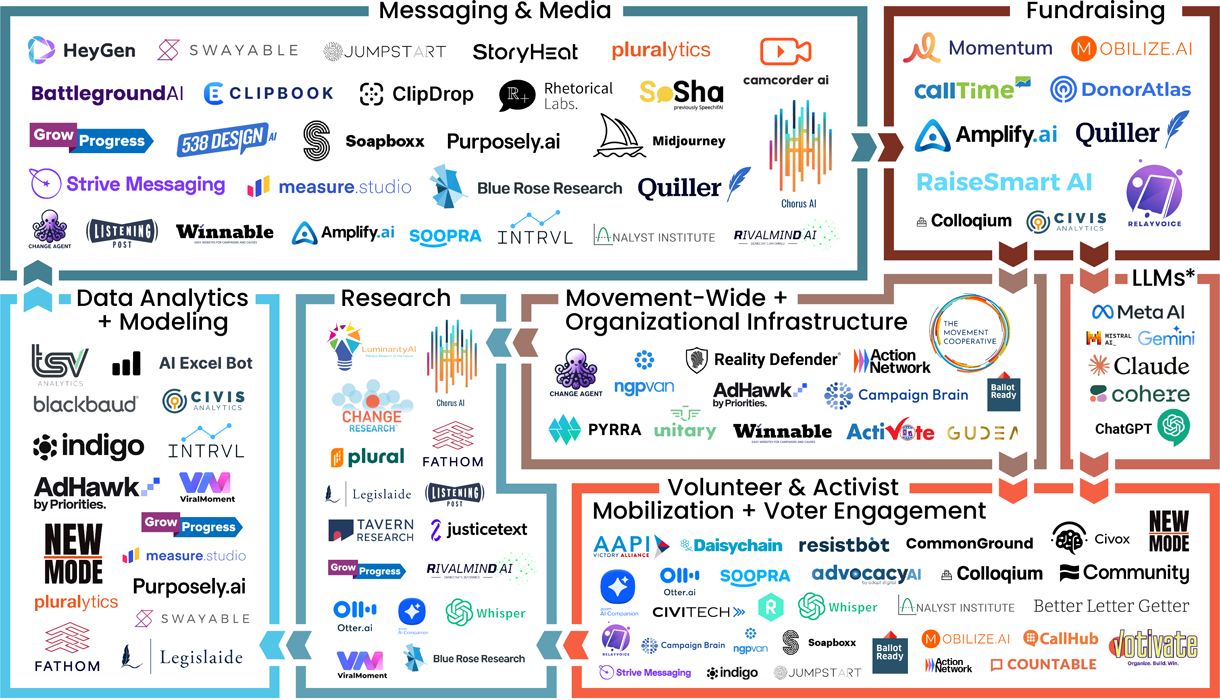
The political tech landscape as shown by HigherGround Labs is heavily dominated by AI-first tools.
As organizations and campaigns committed to changing the political landscape to work for the people rather than corporations, how can we in good conscience utilize tools that are indirectly working against our goals and values?
But don’t despair! There are a few things we can do to fight back. I encourage organizations to make intentional choices about what software you are using, what policies you have around them, and how you are training new members on security best practices.
You should make a list of all the tools your organization uses. It is a good practice to ask yourself in general what is working well with them and what could be better. Figure out what tools are hard to train people on and what tasks seem too manual and tedious. And of course, figure out if they are connected to any venture capital, private equity, or right-wing owners. Pivoting to more values-aligned software can be a defensive way to define your technology stack.
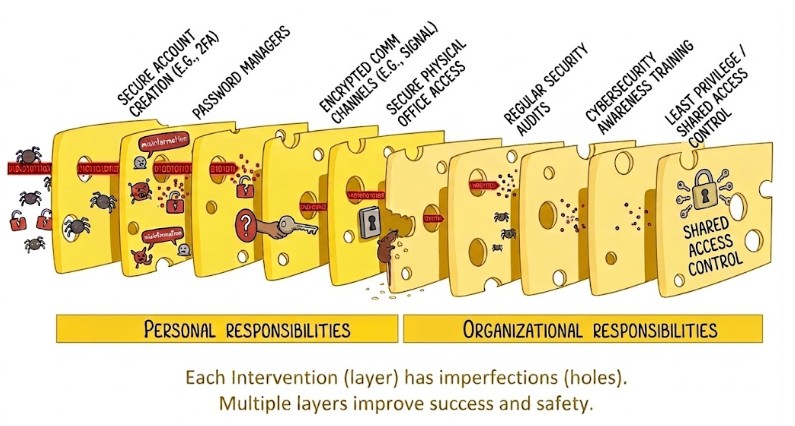
There are offensive tactics to think about too. These come in the form of your policies and practices: Do you have a clear and public data use policy for who you will and will not share member/volunteer data with? Do you regularly audit permission levels as members’ level of involvement changes? Do you follow the principle of least privilege for those permission levels? Do you audit your Signal channels regularly to remove inactive members? Do you use 2FA (two factor authentication) and password managers instead of texting someone a password or storing it on a google spreadsheet?
Training on operational security is an important form of political education we cannot afford to ignore. Think about how you document and train all members on best practices regularly. I’d encourage you to think about the Swiss Cheese Model that was widely shared at the beginning of our ongoing COVID pandemic. Just like multiple actions at both the individual and societal level helped curb the spread of a virus, the same is true with building a strong culture of operational security in your organizations. Steps one and two only get you partway there; training your membership ensures that folks are taking those individual protections seriously too.
Each of those steps can involve a lot of change. Make sure you bring people along for the “why.” Make sure you aren’t doing this alone and that you are tackling one change at a time. Seek feedback regularly. And last but perhaps most importantly: I encourage you to move at the pace of sustainability and bringing everyone along. It can be overwhelming, especially if you are making a lot of changes. But without an intentional process, you can create more problems than you are trying to solve.
To return to the story of recent electoral success, 33rd Ward Working Families took some intentional steps before Miguel’s 40th District campaign, similar to the steps I suggest above. In late 2025, we decided to move away from Nationbuilder. While several of us were making personal efforts to de-Googlify our own lives, we focused on replacing Nationbuilder for three main reasons. The first reason was ideological: its ties to venture capital. The next two reasons were more practical. We knew that our org would experience an influx of new members because of the electoral campaign and Nationbuilder’s clunky interface wouldn’t serve our onboarding needs and would inhibit our abilities to smartly use our membership data. Additionally, we were starting with $0 and wanted to save on costs.
The tool we decided to use instead was Solidarity Tech. Solidarity Tech is built for organizers by organizers. It began as an internal project to build technology to help organize a rideshare drivers' union in California. Founded in 2019, it became available for general use in early 2024. Early on, it became popular for unions and grassroots organizations and was popularized in electoral spaces with the Zohran for NYC campaign. And since I’ve spent most of this article talking about funding, besides payments from large unions, the only investment on record for Solidarity Tech is in 2021 from the Workers Lab.
Besides aligning with our values, as a Product Manager, I care that our tools are easy to use and meet our organizing needs.Here is what appealed to us and ultimately convinced us to switch to Solidarity Tech:
We used Solidarity Tech to build both the IPO and Miguel’s website, emailing, texting, phonebanking, event registration, and donations. That replaces so many separate tools, which helped simplify training and user access. Beyond that, it meant that we could use our data in smarter ways. For example, we could set up automations based on how people interacted with the website and which events they registered for to better identify potential volunteers, send automated emails/texts, etc.
A federated design means your organization can have multiple chapters that users belong to and branches that members are automatically assigned based on geography. One use case we are exploring is to have each precinct in our organization set as a “branch” so that our Precinct Organizers can evaluate which member they may want to recruit to their Precinct team since that is automatically assigned based on geography. We also use “chapters” to separate out the IPO from our member electeds’ campaigns. One example of how this is helpful is that when we launch a new campaign, we can reach out to our most active members of the IPO to ask them about volunteering at the campaign kickoff. Overall, this federated design helps us reduce redundancy and save money on separate instances, while building a more cohesive view on how folks are engaging across these spaces. That would otherwise be invisible or take a lot of manual effort to see.
Because we are an IPO that runs our own members for political office, when we run a member like Rossana or Miguel, we are committing to running their entire campaign – and besides people power, the next most valuable resource we can offer is a direct line to our members. Our movement owns all the data we generate whether it is for our IPO or the campaigns we run, and we want to continue engaging people beyond Election Day and our member electeds’ retirement.
Listen. Nationbuilder was an eyesore, slow, and almost impossible to use on mobile. Solidarity Tech is mobile friendly, easy and fast to use, and has multi-lingual outreach as a core feature rather than an afterthought. Albany Park is the heart of our organizing and the most diverse neighborhood in Chicago, filled with immigrants speaking dozens of languages. Being able to automatically translate our website and having the tool tell us when we should translate a text/email means that we can ensure no neighbor was left behind. Of course there are other aspects of digital accessibility and Solidarity Tech touches on those too, such as an analysis of your texts, emails, and phonebanking scripts, to make sure they are readable.
I cannot tell you how many hours of my day job I have spent talking about layout, number of clicks, and other less superficial aspects of human-centered design. Solidarity Tech is really easy to pick up (but if you disagree, they also have a well-documented wiki). In addition, you might think that given its all-in-one nature, that the quality of each of those modules might be sacrificed. But the opposite is true. A few examples: the phonebanking module allows predictive dialers, voicemail drops, a live dashboard, and so much more. There are advanced filters integrated throughout every module and smart automations and defaults.
Just as we defeated the Old Chicago Machine, we can defeat this New Tech Machine made of corporate gatekeepers. We win because our tech is built on relationships, not just algorithms and AI.
I’m going to be hosting a demo of Solidarity Tech for other IPOs and progressive groups in Chicago that you can RSVP to below. I want to be upfront with my motivations. I want:
Solidarity Tech to continue being funded by progressive organizations that use it and not need to pursue venture capital or private equity avenues to continue existing.
Solidarity Tech to be able to grow so that they can move more sustainably and continue to build a richer feature set for features that movement organizations especially care about (like the field app).
All of us to move away from venture capital/private equity funded tools because I do not want to give my data to another Mobilize RSVP form, or navigate Target Smart VAN’s bloated and confusing interface, and feel the complicity of it all.
https://www.workingfamilies33.org/discussing-movement-tech-st-demo